

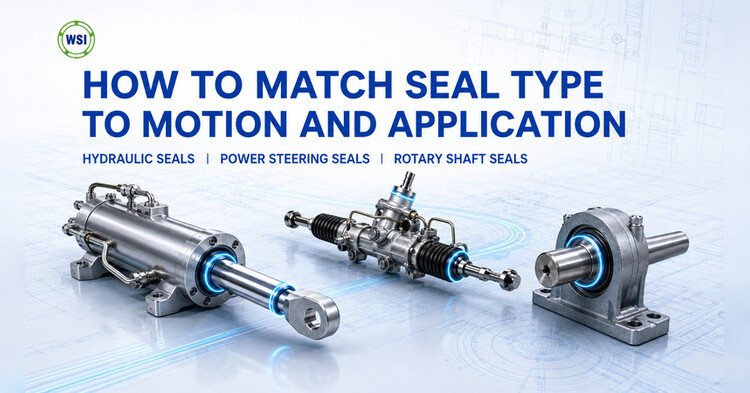
Selecting a seal requires more than matching its dimensions. The correct choice begins with the seal position and motion, followed by the system’s pressure, speed, temperature, fluid, dimensions, and operating environment.
At WSI (Well Oil Seal Industrial Co., Ltd.), we design and manufacture oil seals and sealing components for automotive, hydraulic, and industrial applications. Our product range includes hydraulic seals, power steering seals, and rotary shaft seals. Because these products address different operating requirements, they should not be considered interchangeable solely because they have similar dimensions.
Quick Answer: Hydraulic seals are used within fluid-power systems, power steering seals are matched to specific hydraulic steering applications, and rotary shaft seals are designed for rotating shafts. Selecting the correct type requires identifying its installation position, motion, operating conditions, and sealing function.
1. Reciprocating vs. Rotary Sealing: What Is the Main Difference?
The first step in seal selection is identifying the type of relative motion at the sealing position.
A reciprocating application involves repeated linear movement in two directions. Hydraulic cylinder rods and pistons are common examples. Dynamic seals in these positions must accommodate sliding movement while controlling fluid leakage or pressure loss.
A rotary application involves a shaft turning within a stationary housing. A rotary shaft seal maintains controlled contact with the shaft surface while retaining lubricant and limiting the entry of dust, moisture, and other contaminants.
These movements create different sealing conditions. Reciprocating seals experience repeated direction changes and variations in sliding contact. Rotary shaft seals are exposed to continuous or intermittent circumferential movement, which may generate frictional heat at the sealing lip.
Hydraulic systems may also contain static sealing positions. Therefore, not all hydraulic seals should be described as reciprocating seals. The movement and function must be identified separately at each sealing position.
2. Hydraulic Seals vs. Power Steering Seals vs. Rotary Shaft Seals
Hydraulic seals, power steering seals, and rotary shaft seals are classified from different perspectives. Hydraulic seals form a broad fluid-power sealing category, power steering seals address a specific steering-system application, and rotary shaft seals are primarily classified according to rotary motion.
| Selection point | Hydraulic seals | Power steering seals | Rotary shaft seals |
|---|---|---|---|
| Primary classification | Fluid-power sealing category | Application-specific steering-system seals | Rotary-motion seals |
| Typical equipment | Hydraulic cylinders and fluid-power equipment | Hydraulic power steering systems | Gearboxes, bearings, motors, and rotating machinery |
| Typical movement | Reciprocating or static, depending on position | Depends on the sealing position; WSI’s listed SCJY products are reciprocating | Rotary |
| Main function | Retain fluid, separate pressure zones, or exclude contamination | Retain steering fluid and support hydraulic pressure control | Retain lubricant and limit contaminant entry |
| Important selection data | Position, pressure, stroke, speed, fluid, groove, and surface condition | Application, position, dimensions, fluid, motion, and reference number | Shaft size, speed, lubricant, runout, housing, and surface condition |
| Can it be selected by size alone? | No | No | No |
This comparison provides a general starting point. Actual suitability must still be evaluated according to the specific product design and operating requirements.
Key Takeaways
- Hydraulic seals cover multiple positions and functions in fluid-power systems.
- Power steering seals are matched to specific steering-system requirements.
- Rotary shaft seals are designed for rotating interfaces.
- Dimensions are important, but they do not confirm functional compatibility.
3. How Do Hydraulic Seals Work in Cylinder Applications?
Hydraulic seals help control fluid, pressure, and contamination within hydraulic equipment. A hydraulic cylinder may use several sealing elements because each installation position performs a different function.
At WSI, our current Hydraulic Seal category includes piston seals and wiper seals for reciprocating cylinder applications.
Piston Seals
A piston seal is installed on the piston and separates the pressure zones on opposite sides of the piston head. By limiting fluid bypass, it helps convert hydraulic pressure into controlled linear movement.
Excessive internal bypass may reduce cylinder efficiency, holding capability, and movement stability. Piston seal selection therefore depends on factors such as pressure direction, groove dimensions, sliding conditions, hydraulic fluid, and mating-surface quality.
Rod Seals
In a typical hydraulic cylinder sealing system, a rod seal retains fluid where the piston rod exits the cylinder. Its selection depends on pressure, fluid, rod condition, alignment, sliding speed, and groove design.
The seal must maintain suitable contact with the rod without creating unnecessary friction. Damage, poor alignment, or an unsuitable rod surface can affect sealing performance even when the seal itself is dimensionally correct.
Wiper Seals
A wiper seal, sometimes called a scraper, is positioned near the outer end of the cylinder. Its primary purpose is to remove dust, mud, water, and debris from the rod before these contaminants enter the system.
A wiper is an important protective component, but it is not normally the primary pressure seal. Its role is to protect the internal sealing elements and hydraulic fluid from external contamination.
A hydraulic cylinder should therefore be evaluated as a complete sealing system. The piston, rod, wiper, grooves, surfaces, and operating conditions all contribute to overall performance.
4. What Makes Power Steering Seals Application-Specific?
Power steering seals operate within hydraulic steering systems, where fluid retention and pressure control are important to system operation.
Our current Power Steering Seals range includes SCJY products classified as reciprocating. Buyers can use the listed dimensions and product types as an initial reference when identifying a suitable configuration.
Several factors make power steering seal selection application-specific:
- The seal must match its exact position within the steering assembly.
- Its dimensions and profile must correspond to the mating components and groove.
- Its material must be compatible with the steering fluid and temperature.
- The design must suit the movement at the sealing position.
- Rod, shaft, bore, and housing conditions can affect friction and leakage.
- A drawing, sample, product code, or OEM reference may be needed for identification.
Power steering seals must match the specific profile, material, fluid, motion, and installation requirements of the steering system. Different locations within a system may also require different sealing solutions.
For this reason, we evaluate the available product and application information rather than relying only on the general product name or external dimensions.
5. How Do Rotary Shaft Seals Protect Rotating Equipment?
Rotary shaft seals are installed between a rotating shaft and a stationary housing. They are commonly used to retain oil or grease around internal components while limiting the entry of dust, water, and other contaminants.
At WSI, we provide Rotary Shaft Seal products within our Industrial Seals range. Typical applications include rotating components in gearboxes, bearings, motors, and industrial machinery.
The sealing lip maintains controlled contact with the shaft surface. As the shaft rotates, this contact area must retain the lubricant without creating excessive friction or heat.
Rotary shaft seal performance depends on the complete installation:
- Shaft diameter
- Shaft speed
- Shaft surface finish and hardness
- Shaft runout and eccentricity
- Housing dimensions and alignment
- Lubricant type and level
- Operating temperature
- External contamination
- Installation method
A rough or damaged shaft surface can accelerate lip wear. Excessive runout may create uneven contact, while inadequate lubrication can raise the temperature at the sealing interface.
The shaft, housing, lubricant, operating environment, and seal should therefore be evaluated as one sealing system.
6. Key Factors for Selecting the Right Seal
At WSI, we use the available operating and dimensional information when assisting customers with product identification, seal-selection consultation, or customized sealing-component development.
Motion Type
Determine whether the sealing position is exposed to:
- Reciprocating motion
- Rotary motion
- Oscillating motion
- Static conditions
If an assembly contains multiple types of movement, evaluate each sealing position separately.
Installation Position and Required Function
Identify where the seal is installed and what it must accomplish. Its function may include:
- Retaining hydraulic fluid
- Controlling internal fluid bypass
- Separating pressure zones
- Retaining oil or grease
- Removing contamination from a rod
- Protecting a bearing or gearbox
- Limiting external contaminant entry
Pressure
For hydraulic applications, provide the normal operating pressure, maximum pressure, pressure direction, and any known pressure spikes. These conditions can affect seal deformation, lip loading, extrusion risk, and groove requirements.
If a rotary housing is pressurized, this must also be stated. A standard rotary shaft seal should not be assumed suitable for pressure unless its design and operating conditions have been evaluated accordingly.
Speed
Reciprocating applications are evaluated according to linear sliding speed, stroke, and movement frequency. Rotary applications require shaft speed and, where relevant, surface speed at the sealing lip.
Temperature
Both continuous and peak temperatures should be considered. Seal temperature may be affected by fluid temperature, ambient temperature, startup conditions, frictional heat, and nearby heat sources.
Fluid Compatibility
The sealing material must be compatible with the actual hydraulic fluid, power steering fluid, lubricant, grease, fuel, or other medium. An unsuitable material may swell, harden, soften, shrink, or lose mechanical strength.
Contamination
Dust, mud, water, metal particles, and process debris can damage sealing surfaces. Applications exposed to contaminants may require a suitable wiper, dust lip, or additional exclusion arrangement.
Dimensions and Mating Surfaces
In addition to I.D., O.D., and height, selection may require:
- Groove dimensions
- Installation clearances
- Edge radii
- Shaft or rod finish
- Shaft hardness
- Housing fit
- Runout
- Alignment
- Existing wear
Key Takeaways
- Begin with the sealing position, movement, and required function.
- Evaluate pressure and speed according to the type of motion.
- Confirm temperature and fluid before selecting a material.
- Include shaft, rod, housing, groove, and contamination conditions.
- Treat the seal and mating components as a complete system.
7. What Information Should Buyers Provide When Requesting a Seal?
Complete application information helps us identify a suitable existing product or determine whether further development should be evaluated.
General Application Information
- Equipment or application
- Seal installation position
- Required sealing function
- Motion type
- I.D., O.D., height, and groove dimensions
- Normal and maximum pressure
- Linear speed or shaft speed
- Continuous and peak temperature
- Fluid or lubricant
- Shaft, rod, bore, and housing conditions
- Drawing, sample, product code, or OEM number
- Required quantity
- Current leakage, wear, or contamination problem
Additional Information for Hydraulic Seals
- Cylinder bore or rod diameter
- Piston, rod, wiper, or other sealing position
- Pressure direction
- Stroke and sliding speed
- Hydraulic fluid
- Rod or cylinder surface condition
Additional Information for Power Steering Seals
- Steering-system application
- Installation position
- Existing product type or code
- OEM reference, if available
- Steering fluid
- Drawing or physical sample
Additional Information for Rotary Shaft Seals
- Shaft diameter
- Housing bore
- Seal width
- Shaft speed
- Lubricant
- Housing pressure, if any
- Shaft finish and runout
- External contamination conditions
We provide industrial, automotive, and hydraulic sealing products along with standardized and customized sealing-solution capabilities. Product identification or development direction depends on the supplied technical information and feasibility evaluation.
8. Frequently Asked Questions About Seal Selection
What is the main difference between reciprocating and rotary seals?
Reciprocating seals operate with repeated linear movement, such as the movement of a hydraulic piston or rod. Rotary seals operate around a turning shaft. Their profiles, friction conditions, lubrication requirements, and mating surfaces are therefore different.
Are power steering seals a type of hydraulic seal?
Power steering seals used in hydraulically assisted steering systems can be considered application-specific hydraulic sealing components. However, their geometry, installation position, fluid, and operating requirements may differ from those of general hydraulic seals.
What is the difference between hydraulic seals and rotary shaft seals?
Hydraulic seals are used at different positions within fluid-power systems and may operate under reciprocating or static conditions. Rotary shaft seals are designed for rotating shafts and generally retain lubricant while limiting external contamination.
Can a rotary shaft seal be used for reciprocating motion?
It should not be assumed suitable. Rotary and reciprocating seals are developed for different directions of movement, contact conditions, lubrication behavior, and wear patterns.
Can seal size alone determine the correct replacement?
No. In addition to dimensions, the seal profile, material, movement, pressure, speed, temperature, fluid, groove, and mating surfaces must be evaluated.
What information is needed to select the correct seal?
At minimum, provide the application, installation position, movement, dimensions, pressure, speed, temperature, fluid, and operating environment. Drawings, samples, product codes, and OEM references can support more accurate identification.
Conclusion
Selecting between hydraulic seals, power steering seals, and rotary shaft seals begins with identifying the sealing position, movement, and required function.
Hydraulic seals perform different roles throughout fluid-power systems. Power steering seals must match the geometry and operating conditions of the steering application. Rotary shaft seals are used around rotating components where lubricant retention and contamination control are required.
At WSI, we provide oil seals and sealing components for automotive, hydraulic, and industrial applications. Our capabilities include sealing-component design, mold development, manufacturing, testing, product-selection consultation, customized sealing solutions, and failure diagnosis.