

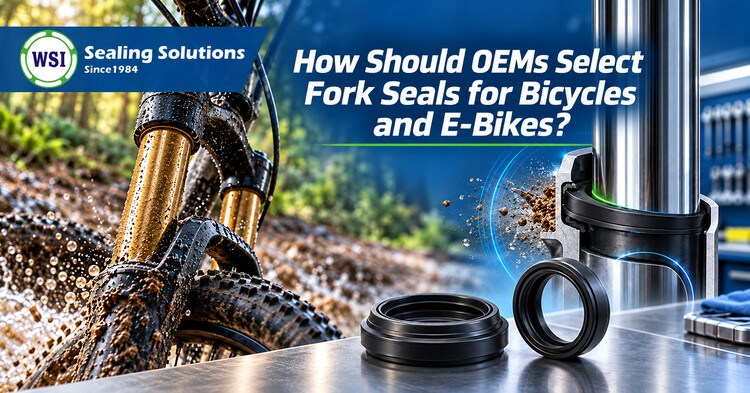
Fork seals are small components, but their condition directly affects suspension smoothness, contaminant control, lubricant retention, and long-term fork reliability.
For bicycle and e-bike applications, choosing a seal by dimensions alone is not enough. At WSI, we recommend evaluating the fork structure, motion, operating environment, material, lip design, mating surfaces, lubrication, and validation requirements together. This guide explains the information buyers and engineering teams should confirm before selecting or developing a fork sealing solution.
1. Start with the Fork Design and Operating Conditions
The first step is to define how the fork is designed and where it will operate. A suspension fork on a commuter bicycle does not face the same contamination, travel frequency, impact, temperature, or service requirements as a mountain bike or a heavier e-bike. Even when nominal seal dimensions appear identical, the correct profile and material may differ.
Buyers should identify the fork type, tube arrangement, stroke, movement speed, lubricant, expected temperature range, external contaminants, cleaning methods, service interval, and target lifetime. E-bike applications may also introduce higher vehicle weight, longer operating distance, and different load patterns. These factors do not automatically require one specific seal; they must be considered as part of the complete sealing system.
- Define the bicycle or e-bike application before selecting the seal.
- Provide real operating conditions, not dimensions alone.
- Evaluate contamination, motion, lubricant, temperature, and maintenance together.
2. Understand the Functions of the Fork Sealing System
A fork sealing system may use more than one functional element. Depending on the design, the system can include an oil seal, dust wiper, scraper lip, support element, foam ring, or other components selected by the fork manufacturer. These parts should work together rather than be treated as interchangeable items.
Oil Retention and Contaminant Exclusion
The oil-sealing lip helps retain lubricant inside the fork, while the external wiping function limits the entry of dust, mud, water, and other contaminants along the moving tube. If lip load is too low, leakage or contaminant entry may increase. If it is unnecessarily high, friction, heat, and wear may rise.
Protection of Internal Components
Effective contaminant exclusion helps protect bushings, tube surfaces, lubricant, and internal sealing components. However, a seal cannot compensate for damaged tubes, poor alignment, incorrect grooves, insufficient lubrication, or improper installation. Fork performance depends on the whole assembly.
- Oil retention and contaminant exclusion are related but different functions.
- Seal elements must be evaluated as a complete system.
- A good seal cannot correct damaged or misaligned mating components.
3. Confirm Dimensions, Grooves, and Mating Surfaces
Nominal inner diameter, outer diameter, and height are essential, but they do not fully define a fork seal. The seal profile, lip geometry, interference, groove design, housing condition, tube diameter, tube finish, hardness, coating, runout, alignment, and assembly method can all affect performance.
| Item to Confirm | Why It Matters | Useful RFQ Information |
|---|---|---|
| Seal and groove dimensions | Affect retention, compression, and assembly fit | Drawing, tolerances, groove dimensions, housing material |
| Moving tube | Directly contacts the sealing or wiping lip | Diameter, tolerance, finish, hardness, coating, condition |
| Concentricity and alignment | Uneven contact may accelerate wear or leakage | Assembly runout, alignment limits, bushing arrangement |
| Lead-in and installation path | Sharp edges may damage the lip during assembly | Chamfer, tooling, installation direction, assembly sequence |
| Reference part | Helps identify profile details not shown by basic dimensions | Existing sample, cross-section, failure sample, photographs |
When replacing an existing seal, buyers should also check why the original part failed. Repeating the same dimensions without reviewing tube wear, scratches, corrosion, misalignment, contamination, or installation damage may reproduce the same problem.
- Three basic dimensions do not fully specify a fork seal.
- Tube finish, groove design, alignment, and installation affect sealing results.
- Send drawings and samples whenever possible.
4. Match Seal Material to the Environment
Elastomer selection should be based on the lubricant, temperature, exposure, friction target, wear conditions, ozone and weathering requirements, and expected service life. Material names alone do not guarantee performance because compound formulation and part design also matter.
| Material Family | General Characteristics | Points to Verify |
|---|---|---|
| NBR | Commonly considered for oil resistance, wear performance, and cost balance | Actual oil compatibility, temperature range, weather exposure, compound grade |
| HNBR | May provide improved heat, aging, and mechanical performance compared with conventional NBR compounds | Lubricant compatibility, low-temperature behavior, friction, cost |
| FKM | Often selected for higher-temperature and chemical-resistance requirements | Low-temperature performance, friction, application need, total cost |
| PU | Can provide strong abrasion and extrusion resistance in suitable designs | Hydrolysis resistance, temperature, lubricant, lip behavior, installation |
This table is an initial comparison, not a final material specification. The final compound should be validated with the actual fork oil or grease and realistic operating conditions. For standardized rubber-property classifications, engineering teams may also consult SAE J200; the applicable material requirements must still be defined for the specific product.
- Select the compound using actual lubricant and environmental data.
- Do not treat every compound within one material family as identical.
- Confirm material performance through application-specific testing.
5. Balance Friction, Sealing, and Durability
Low breakaway force and smooth movement are important to suspension feel, but the lowest possible friction is not the only design goal. The seal must also retain lubricant, exclude contaminants, tolerate dimensional variation, and provide suitable wear life. Reducing lip contact without understanding the complete system may increase leakage or contaminant entry.
The practical target is controlled friction with reliable contact. Lip geometry, compound properties, surface finish, lubrication, pressure conditions, tube coating, temperature, and assembly tolerances all influence the result. Friction data should therefore be compared under defined and repeatable test conditions.
- Low friction must be balanced with leakage control and contaminant exclusion.
- Compare test data only under equivalent conditions.
- Evaluate the seal together with the tube, lubricant, and fork structure.
6. Validate Samples Before Production
Prototype and validation testing help confirm whether a proposed seal works in the real assembly. Dimensional inspection alone cannot reproduce the combined effects of motion, side load, temperature, lubricant, contamination, pressure variation, installation, and long-term wear.
Recommended Validation Items
- Incoming dimensions and visual condition
- Assembly fit and lip condition after installation
- Breakaway and running friction under defined conditions
- Lubricant leakage during cycling and static storage
- Dust, mud, water, or contaminant-exclusion testing
- Temperature and lubricant-compatibility evaluation
- Endurance cycling followed by seal and tube inspection
- Performance after realistic cleaning and maintenance procedures
Acceptance criteria should be agreed before testing. If the customer requires a specific standard, test fixture, duty cycle, contamination medium, or pass/fail limit, these requirements should be included in the project documentation.
- Validate seals in the intended assembly whenever possible.
- Define test conditions and acceptance criteria before testing.
- Inspect both the seal and mating components after endurance tests.
7. Prepare a Complete Fork Seal RFQ
A complete RFQ helps us evaluate feasibility and reduces repeated clarification. For a standard replacement, provide the existing seal marking, exact dimensions, application, annual demand, and sample if available. For a new or customized design, drawings and operating data are especially important.
Information to Include
- Bicycle or e-bike type and fork application
- Seal drawing, groove drawing, and assembly drawing
- Tube diameter, tolerance, finish, hardness, and coating
- Stroke, movement speed, load conditions, and pressure conditions if applicable
- Lubricant brand or specification
- Temperature range and expected contaminants
- Required material, color, marking, and packaging
- Target friction, leakage, endurance, and contamination-test criteria
- Existing sample and failure information
- Prototype quantity, annual volume, and project schedule
At WSI, we manufacture sealing products for automotive and industrial applications and evaluate sealing requirements based on customer drawings, samples, specifications, and operating conditions. Final design, material, testing, tooling, and production feasibility must be confirmed for each project.
- A detailed RFQ supports faster and more accurate evaluation.
- Include performance targets as well as dimensions.
- Final recommendations depend on confirmed application data and validation results.
Frequently Asked Questions
Can I select a bicycle fork seal by inner diameter, outer diameter, and height only?
No. These dimensions are necessary, but lip profile, interference, groove geometry, tube finish, material, lubricant, contamination, alignment, and installation conditions can also affect performance. A drawing or physical sample is recommended.
Are bicycle and e-bike fork seals the same?
Not necessarily. Some designs may use similar seals, but suitability depends on the actual fork structure, vehicle weight, travel, operating environment, service interval, and performance targets. The application must be reviewed rather than assumed from the vehicle category.
Which material is best for a fork seal?
There is no universal best material. NBR, HNBR, FKM, PU, and other compounds offer different balances of oil compatibility, temperature resistance, wear, friction, weathering, and cost. Selection should be based on actual application data and testing.
Does lower seal friction always improve fork performance?
No. Friction must be balanced with lubricant retention, contaminant exclusion, dimensional variation, and durability. A lower contact force may feel smoother but can create leakage or contamination risks if the complete sealing system is not considered.
What information does WSI need to evaluate a custom fork seal?
Please provide seal and assembly drawings, tube specifications, groove dimensions, lubricant, temperature, stroke, speed, contaminants, performance targets, test requirements, samples, expected volume, and project schedule. WSI can then evaluate material, design, tooling, testing, and production feasibility.
Discuss Your Fork Sealing Requirements with WSI
Send us your drawings, samples, operating conditions, lubricant information, performance targets, and required quantity. Our team can evaluate the appropriate sealing direction and confirm project feasibility based on your specifications.
Contact WSI